

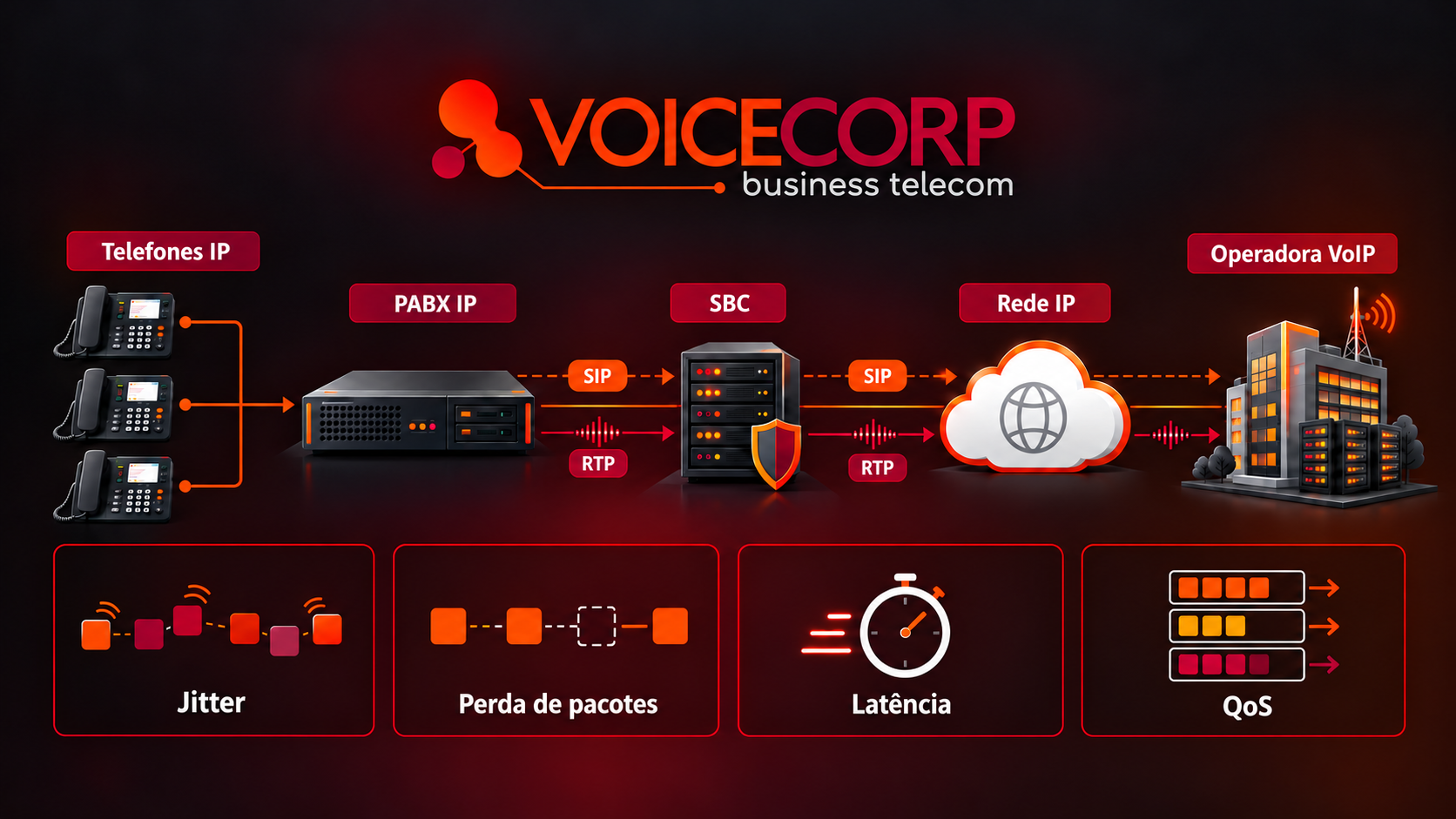
SIP Trunk and voice quality: what really happens behind an IP call?
In corporate telephony, completing a call does not necessarily mean guaranteeing quality communication.
Behind each SIP link, there is an architecture of signaling, media transport, session control and traffic management that directly influences the user experience.
But, after all, what factors determine the quality of a VoIP call?
Jitter: stability in package delivery
Jitter represents the variation in the arrival time of RTP media packets. When this variation exceeds the jitter buffer's ability to compensate, clipping, flickering, and distortion can occur in the audio. Proper control requires analysis of network conditions, buffers, and RTP stream behavior.
Packet loss: when the voice does not arrive complete
The loss of RTP packets compromises the integrity of the transmitted media. Its effects vary according to the intensity, duration and distribution of losses, in addition to the codec used. Congestion, discard on interfaces, link problems, and configuration failures are among the factors that deserve investigation.
Latency: The Impact of Conversation Delay
Latency influences the naturalness of the dialogue. The longer the end-to-end delay, the greater the possibility of overlapping speech and interaction difficulties. As an engineering reference, it is recommended to aim for one-way latency close to or less than 150 ms, considering that the full media path includes networking, processing, and buffers.
QoS: Priority for voice traffic
In converged environments, voice and data share network resources. Quality of Service (QoS) mechanisms, traffic classification, DSCP tagging, and queue policies help prioritize voice packets in congestion situations. However, its effectiveness depends on the consistent configuration along the communication path.
SIP and RTP: Signage and media are different
The SIP is responsible for establishing, managing, and closing sessions. Audio media is usually transported over RTP, often over UDP. Therefore, a call may have apparently normal SIP signaling and still suffer audio degradation due to problems in transporting the media.
SBC: Control, Interoperability and Security
The Session Border Controller acts at the border between communication networks, applying session control policies, protection against improper traffic and interoperability mechanisms. Depending on the architecture, it can also assist in handling NAT, managing media streams, and protecting against fraud attempts.
Which indicators deserve attention?
As initial references, voice engineering usually seeks to:
- One-way latency near or less than 150 ms.
- Low jitter is compatible with the jitter buffer capability.
- Packet loss close to zero, preferably less than 1%.
- MOS — Mean Opinion Score — appropriate to the expected experience.
- Codec, available bandwidth, and QoS parameters correctly sized.
These values must be interpreted together. No single indicator guarantees a good experience, and measurements need to consider both directions of communication.
The challenge of IP telephony goes beyond connecting systems
Quality infrastructure requires visibility into SIP signaling, SDP negotiation, RTP streams, link performance, network policies, and security mechanisms. It is this integrated analysis that allows you to identify bottlenecks, reduce failures, and increase the reliability of corporate communications.
At Voicecorp, we believe that the evolution of telephony involves the convergence between connectivity, engineering, security and operational intelligence.
And in your VoIP infrastructure, which factor usually represents the biggest challenge: jitter, packet loss, latency, or QoS configuration?
Share your experience and participate in this discussion about the future of corporate telephony.
Voicecorp Telecommunications — technology and engineering at the service of business communication.
