

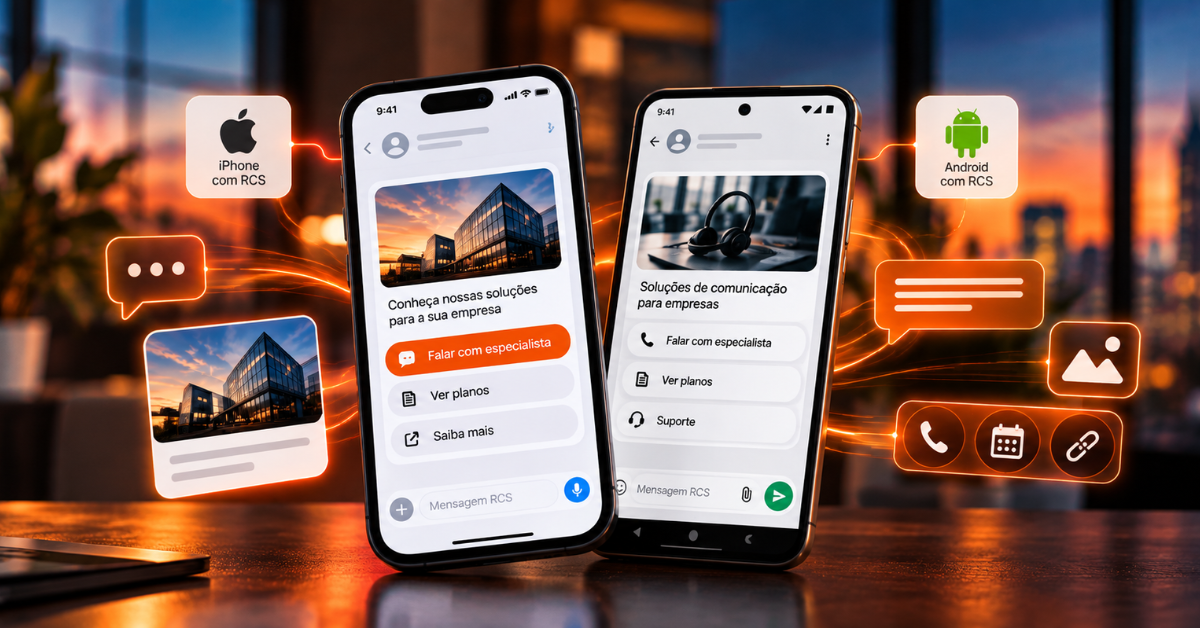
RCS in iPhone and Android: what has changed and why it accelerates the channel
RCS is no longer just a matter of Android
For years, RCS has been primarily associated with the Android ecosystem and Google Messages.
This scenario changed with the adoption of RCS by Apple.
Support for the standard has amplified the channel's strategic relevance because it brings the two major mobile ecosystems closer together around an industry-standard-based messaging technology.
RCS in the iPhone
The Apple informs that the iPhone supports RCS from iOS 18, as long as the carrier and plan are compatible.
With RCS, users can have features such as sending higher quality media, delivery and reading receipts, and typing indicators, depending on availability.
In 2026, Apple also began making end-to-end encryption available in beta in RCS compatible conversations in iOS 26.5. This evolution concerns the RCS messaging ecosystem and should not be automatically confused with all enterprise RCS flows.
What about RCS for Business in iPhone?
This is a point that needs precision.
The Google recognizes that Apple develops its own RCS implementation, including for RCS for Business capabilities. Availability depends on Apple and carriers' release choices.
Therefore, an enterprise should not assume that every enterprise RCS feature will be available on every iPhones, network, or system version.
Professional campaigns should verify capabilities and test the experience on the target audience's devices.
Android remains a core ecosystem for enterprise RCS
In Android, Google Messages is one of the top RCS clients and provides broad support for RCS for Business.
Features such as verified agents, rich cards, carousels, replies, and suggested actions are all part of the Google ecosystem.
Documentation also evolves frequently. In 2026, Google added and expanded persistent suggestion capabilities and updated branding and verification standards.
Why is this important for Brazilian companies?
The larger the base of supported devices, the greater the potential for a RCS-based business strategy.
The adoption of the standard by Apple reinforces RCS as the industry's messaging infrastructure, not just as a single-vendor resource.
This makes it an interesting time for companies to start testing journeys, building agents, organizing identity, and preparing integrations.
RCS in 2026: a continuously evolving channel
The RCS is still evolving.
The GSMA published Universal Profile 4.0 and later 4.1 in 2026, bolstering features, interoperability and security.
This means that companies must work with partners who follow the ecosystem, because features, compatibility and good practices continue to change.
Talk to Voicecorp
Voicecorp now offers enterprise SMS and RCS solutions for communication, service, notifications, and campaigns. Talk to our team to structure the best strategy for your operation.
0800 102 4141 | voicecorp.com.br
Official references
Apple — Difference between iMessage, RCS, and SMS/MMS: https://support.apple.com/pt-br/104972
Apple — RCS with end-to-end encryption in beta: https://www.apple.com/br/newsroom/2026/05/end-to-end-encrypted-rcs-messaging-begins-rolling-out-today-in-beta/
Google — RCS for Business and iOS: https://developers.google.com/business-communications/rcs-business-messaging/support/overview/troubleshooting?hl=pt-BR
GSMA — Universal Profile 4.1: https://www.gsma.com/solutions-and-impact/technologies/networks/gsma_resources/rich-communication-service-rcs-july-2026-publications/
VOICECORP business telecom
