

Your company’s name on a call: what Origem Verificada is and how it works
A call from an unknown number can immediately raise a question: who is calling? For companies that need to speak with customers, making that contact recognizable is an important part of communication.
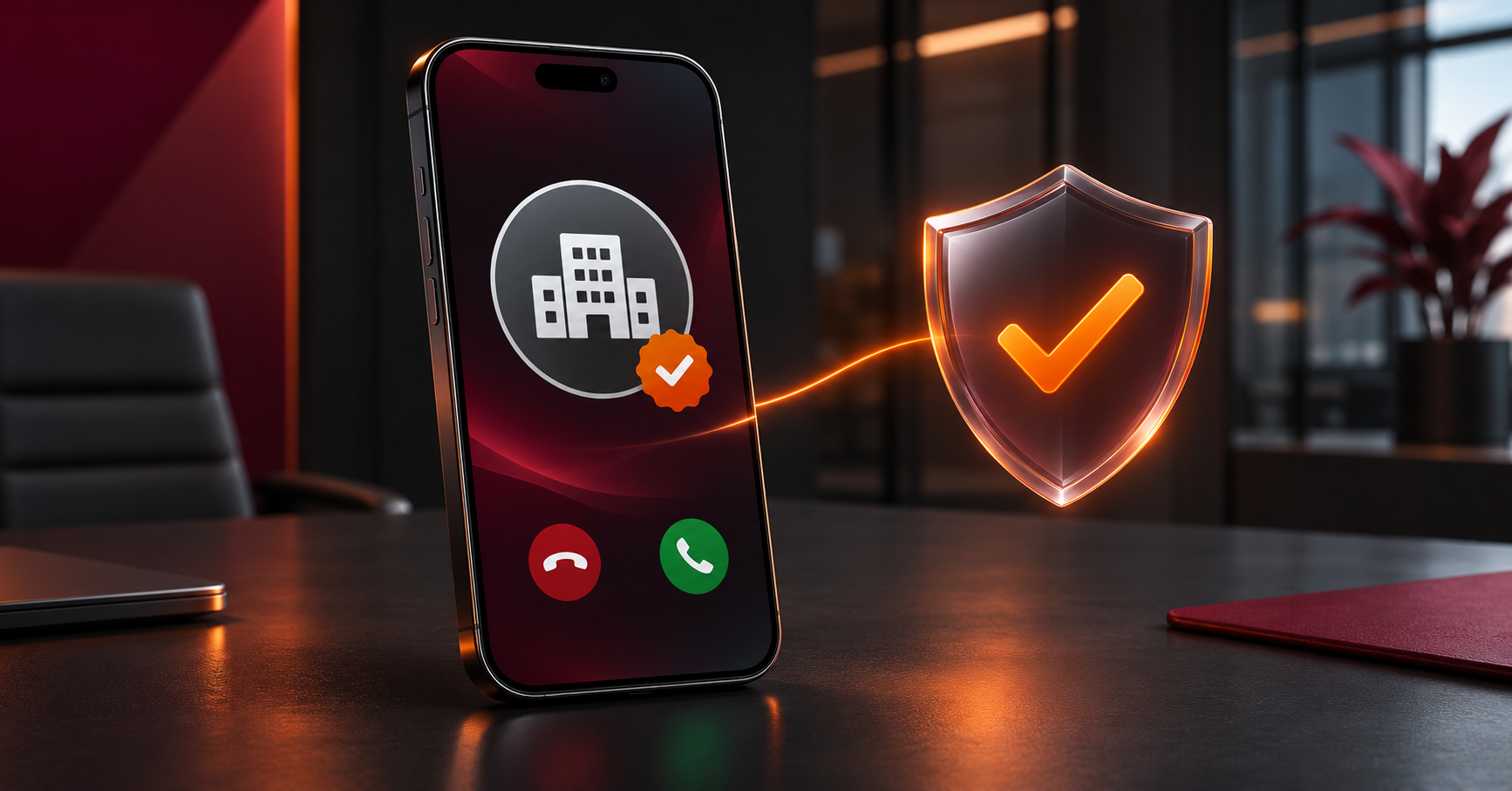
Origem Verificada combines number authentication with caller identification. Where compatible, a mobile phone can display company information before the call is answered, even if the number is not saved in the recipient’s contacts.
Understanding these functions helps you assess what the technology offers and the conditions needed for it to work.
What is Origem Verificada?
Origem Verificada is a call authentication and identification service implemented by the Identification and Authentication Authority, known as AIA, through ABR Telecom.
It combines two functions:
Authentication: technically verifies the origin of the number presented in the call.
Identification: presents information about the caller, such as the company’s name.
These functions complement each other. Validating the origin of a number and displaying a brand on screen involve different capabilities.
How the company’s name appears on a call
During an authenticated and identified call, a compatible mobile phone may display:
- Company name
- Phone number
- Logo
- Reason for the call
- An authentication indicator, such as a badge or a “Validated Number” message
The presentation varies according to the device and available capabilities. These elements therefore do not necessarily all appear on every call.
Imagine a technical service company calling to confirm a visit. When identification is available, the customer can recognize the company before answering and understand the context of the call.
The role of STIR/SHAKEN
STIR/SHAKEN is the set of technical standards used to authenticate the originating identity of calls. The framework involves checking identification information and certificate governance that supports trust between networks.
RCD, or Rich Call Data, allows additional information to be included, such as the name, logo and reason for the call.
In practice, the process has three stages:
- The company places the call through enabled infrastructure.
- Authentication mechanisms verify the originating information.
- The network delivers the call, and a compatible device displays the available data.
What is spoofing, and how does authentication help?
Spoofing is the falsification of the number displayed to the person receiving a call. It can be used to make a call appear to originate from a familiar organization.
STIR/SHAKEN helps combat this practice by enabling technical verification of the originating identifier. This strengthens trust in the information accompanying the call.
What are the requirements?
Display depends on the telephony infrastructure and the recipient’s device. Requirements include:
- A compatible smartphone
- A 4G or 5G network supporting the technology
- VoLTE enabled on the device and by the carrier
- An updated operating system
- A call routed through a voice network that supports the feature
VoLTE is the technology that allows voice calls over a 4G network.
Incompatible phones still receive calls but may display only the number. Recipients do not need an additional subscription for identification, and there is no specific charge to them for it.
How a company can assess adoption
The first step is to ask a participating provider about availability, commercial terms and technical requirements.
Adoption involves registering and validating company information, associating the numbers and configuring identification data.
Before signing up, ask:
- Which numbers will be able to use the solution?
- Does the service include authentication and visual identification?
- What information may appear?
- What limitations apply to destination networks and devices?
- How will registration and updates be handled?
Having IP telephony or a cloud PBX alone does not mean identification is enabled. You need to confirm this with the provider.
A verified call still requires caution
Authentication helps confirm the origin of the number. It does not assess whether a request made during the conversation is safe.
Even on an identified call, avoid sharing passwords or access codes. If in doubt, end the call and contact the organization through its official channels.
Similarly, a call without a badge is not automatically fraudulent: its absence may be related to compatibility or feature availability.
Business telephony starts with clear information
Understanding authentication, identification and compatibility helps a company evaluate solutions with realistic expectations and ask providers more precise questions.
Voicecorp follows developments in business telephony and shares knowledge to help companies understand technologies that affect their communications.
Want to explore Voicecorp’s business telephony solutions? Contact us at 0800 102 4141.
