

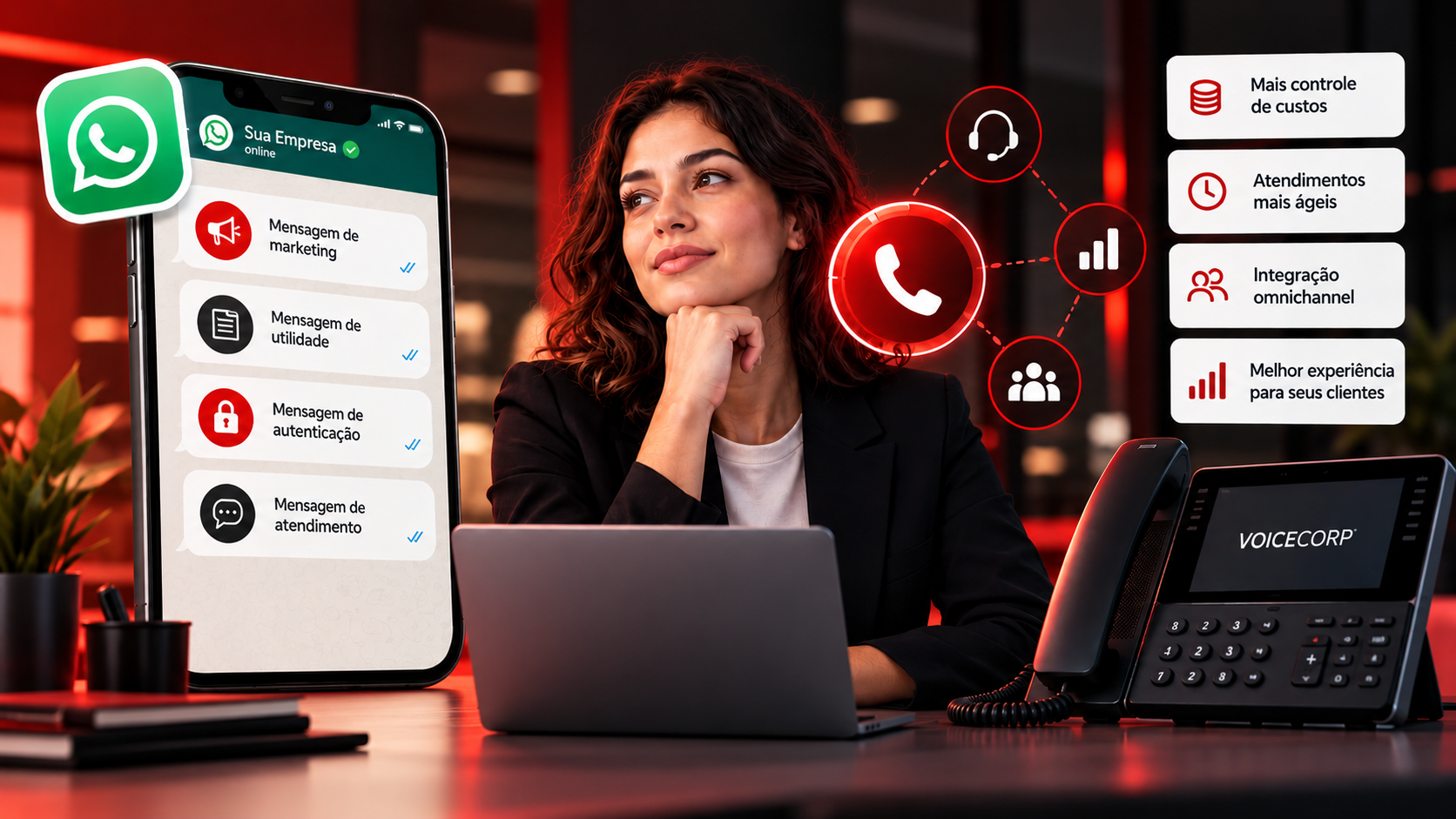
New WhatsApp Costs: Why VoIP Telephony Is Strategic for Reducing Customer Service Costs
In recent years, the WhatsApp Business Platform (API official) has consolidated itself as one of the most used channels for corporate communication. However, the evolution in Meta's collection policies requires extra attention from financial and service managers.
Since October 1, 2026, new rules have impacted the operating costs of companies that use the official API to serve their customers.
Given this scenario, corporate telephony — especially VoIP Telephony — gains even more relevance as a strategic solution to optimize expenses, expand communication possibilities, and maintain the quality of service.
Understanding Meta's cost changes in WhatsApp
One of the advantages of the WhatsApp Business Platform was the possibility of responding to customer messages free of charge within the 24-hour service window, through human attendants or automation systems.
With the update implemented by Meta in October 2026, this dynamic has changed:
- Billing for service messages: As of October 1, 2026, service messages sent by the company within the 24-hour window are now charged per delivered message, after a monthly allowance of 1,000 free messages per business number.
- Impact on message volume: In long dialogues, in which several support or negotiation messages are exchanged, each response sent by the company after the free limit can represent an additional cost.
- Template charges: Marketing, Utility, and Authentication messages are still subject to Meta's fees. An important change is that utility templates sent within the 24-hour service window are also now charged.
- Special free conditions: Certain interactions initiated by click-to-WhatsApp ads or other free entry points continue to have specific exemption conditions, as per Meta's rules.
For messages intended for Brazilian numbers, the reference rate in force since October 2026 is R$ 0.035 per service message delivered, after the consumption of the monthly allowance. Marketing messages have a reference rate of R$ 0.3217, while utility and authentication messages have a base rate of R$ 0.035.
These amounts may vary depending on the billing currency, commercial conditions and any updates from Meta.
It is worth noting that these rules apply to the WhatsApp Business Platform (API official), and not to the conventional use of the WhatsApp Business application.
With this model, the cost of long calls also depends on the number of messages sent by the company, making financial monitoring even more important.
Source: Meta for Developers — WhatsApp Business Platform Pricing.
VoIP telephony as a strategic and economical solution
To balance the budget and avoid the concentration of operating costs in a single channel, the integration of VoIP Telephony with customer service emerges as a strategic alternative.
Unlike individual charging for delivered messages, VoIP telephony offers different contracting modalities, including plans with predictable monthly values and call packages, according to the conditions of each operator.
This flexibility allows companies to evaluate the most appropriate channel for each type of service, considering the volume of interactions, the complexity of the requests, and the costs involved.
1. Excellent cost-effectiveness and financial predictability
While WhatsApp Business API started to charge certain responses individually, VoIP phone plans can offer predictable monthly costs, call packages, and commercial conditions appropriate to the company's usage profile.
This facilitates financial planning and allows you to have longer conversations without depending on the number of messages exchanged.
In operations with a large volume of calls, VoIP telephony can represent an economically advantageous alternative, especially when used strategically and complementary to digital channels.
The effective savings depend on the contracted plan, the volume of calls and the company's service profile.
2. Agility in solving complex problems (FCR)
Complex services or those with many questions may require long exchanges of messages on the WhatsApp. In addition to increasing the number of responses subject to collection, this flow can lead to a delay in resolution and wear and tear on the customer experience.
A single call via VoIP can allow the alignment of information, the clarification of doubts, and the conclusion of negotiations in a more direct and humanized way.
This model can also contribute to improving First Contact Resolution (FCR), an indicator used to assess the ability to resolve customer requests without the need for new contacts.
By making voice communication available as an alternative, companies offer more flexibility and allow the customer to choose the form of service that best suits their needs.
3. Integration and operational efficiency
Modern VoIP telephony can be integrated with CRM systems, Virtual PBX, and omnichannel service platforms, depending on the compatibility of the solutions used.
Features such as IVR, call recording, service queues, extensions, and performance reports provide more organization and control over corporate communication.
With Voicecorp's VoiceHub, Cloud PBX, your company can structure telephone service, organize calls between teams, and track important information for operation management.
In addition, the flexibility of cloud telephony allows employees to make and receive calls from different locations, using compatible devices and internet connection.
These features help to professionalize the service and complement the digital channels already used by the company.
The omnichannel balance: maximizing results
Adopting VoIP telephony does not mean abandoning WhatsApp, but using them in a complementary and intelligent way.
An efficient communication strategy considers the characteristics of each channel and directs interactions according to the needs of customers.
1. WhatsApp for digital notifications and interactions
Keep the WhatsApp as a strategic channel for confirmations, notifications, sending information and timely contacts. The platform continues to be important for companies that need to offer practicality and agility in communication.
2. VoIP for support and sales
Direct more complex services, technical support, commercial negotiations, and situations that require immediate responses to VoIP telephony, when voice communication is more efficient.
This strategy can reduce the need for extensive message exchanges and contribute to a better service experience.
3. Omnichannel to centralize communication
With Voicezap, Voicecorp's omnichannel solution, your company can bring together services from different channels, such as WhatsApp, voice, and social networks, in a more organized operation.
Centralization makes it easier to track interactions, distribute contacts across teams, and manage customer relationships.
This way, your company does not have to choose between WhatsApp and VoIP telephony. The two technologies can work together to offer more efficient communication that is appropriate to the needs of the business.
Conclusion
With the changes implemented by Meta in October 2026, companies need to reevaluate their communication strategies and more closely monitor the costs associated with serving the WhatsApp Business API.
While WhatsApp remains a key channel for customer relationships, relying solely on it can increase your company's exposure to changes in business policies and platform fees.
In this scenario, VoIP telephony reaffirms its importance as a modern, flexible and scalable technology, capable of complementing digital service and contributing to a more efficient management of corporate resources.
By combining IP telephony, Cloud PBX, and omnichannel solutions, companies can diversify their channels, improve the customer experience, and seek greater financial predictability.
Is your company prepared for the new costs of digital communication?
With Voicecorp, you will find IP telephony, Cloud PBX, and omnichannel service solutions to modernize your operation and optimize business communication.
Talk to Voicecorp and find the ideal solution for your company or call 0800 102 4141.
Sources and references
- Meta for Developers - WhatsApp Business Platform Pricing: Official documentation on the billing model, message categories, and pricing conditions of the WhatsApp API.
- Kinbox — WhatsApp Business API: What changes on October 1, 2026, and how to prepare. Published on September 29, 2026.
- WizeBot — Service messages in WhatsApp: What's changing in October 2026.
- Letalk — Service message billing in WhatsApp: what changes in October 2026. Published on September 30, 2026.
Editorial note: Figures shown are October 2026 references and may be changed by Meta. To see the fees applicable to your operation, check the official documentation and billing conditions for your account.
